
Glass by Peter Layton
|
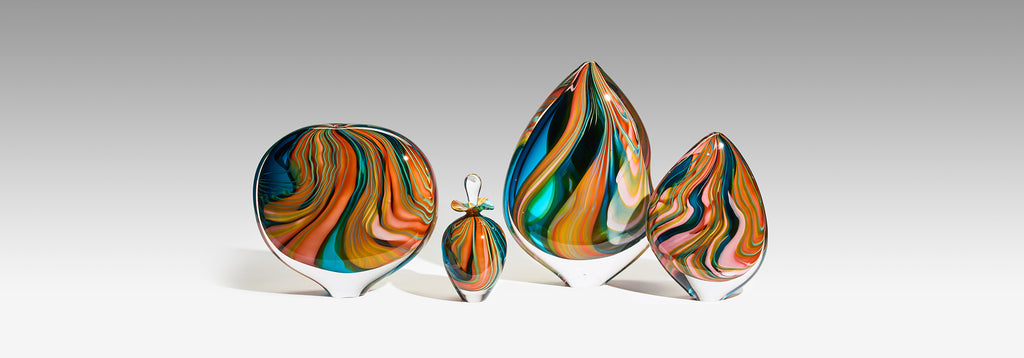
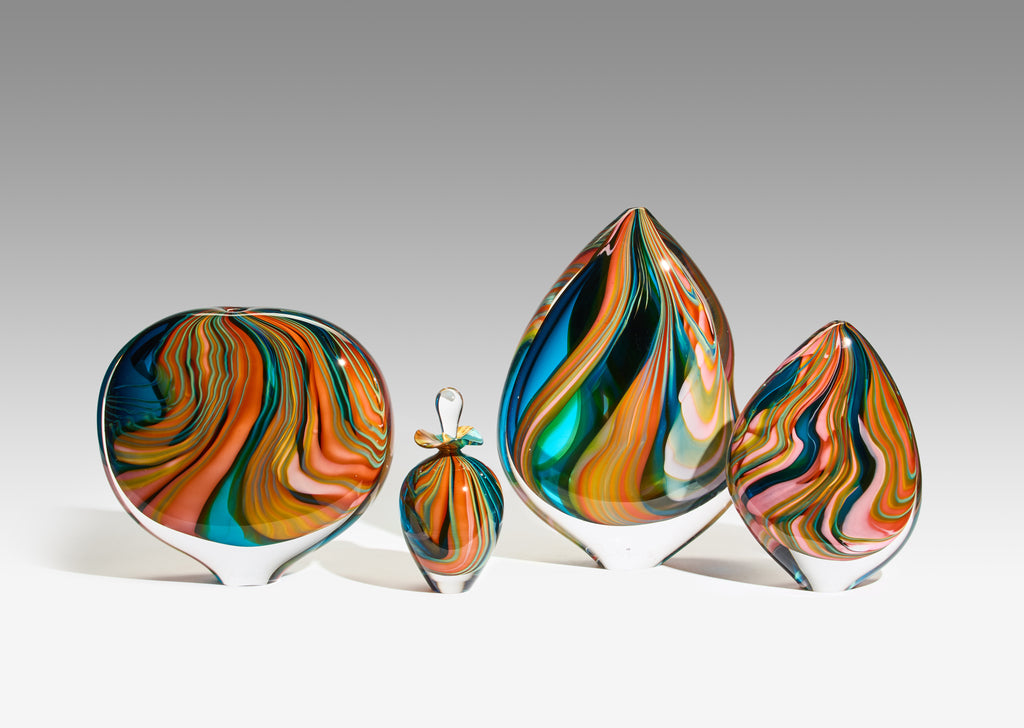
Peter Layton originally trained in ceramics, but the discovery of hot glass was the beginning of a love affair. He was inspired by the immediacy of this engaging yet elusive medium, and as much by the demanding process as the magical qualities of the material. Each piece represents an adventure and a challenge to control form and colour, while allowing the fluidity of the glass to contribute its own qualities and characteristics.
Self-taught as a glassmaker, Peter Layton's work is organic and tactile, striving to achieve a form of controlled asymmetry. His series evolve by 'sketching on the blowing iron' in the belief that an understanding of the work is best achieved through making. An inveterate beachcomber, his work is often drawn from some aspect of nature or something observed while travelling.
|
A collection of glass art, interpreting Hockney’s striking use of light, colour and form.
|
Ariel
Fresh abstract gestural movement in strong blue hues.
|
Floral
Emulating the subtlety and delicacy of watercolours reminiscent of Monet in Giverny.
|
Giraffe
Developed by reversing the colours of an image on the computer.
|
Reflecting ice and snow layers over fields, hedgerows, trees and hillsides.
|
Lagoon
Released to celebrate our first anniversary in Bermondsey Street.
|
Landscape
Evoking impressionistic meadows, spring flowers and big skies, sometimes stormy.
|
Lapis
Expresses the cool fresh colours of a babbling brook in Spring.
|
Inspired by blossom in our early days at Rotherhithe.
|
Mirage
Inspired by visiting Petra, a city hewn from sedimentary sandstone.
|
Nautilus
Evokes the amazing photographs of Earth taken from outer space.
|
Paradiso
Strong gestural mark-making in vibrant colours, influenced by the paintings of Hodgkin and Hockney
|
My impression of the Barrier Reef – one of the highlights of my life.
|
Skyline
Drawn from brilliant ever-changing sunsets.
|
Spirale
Uses an original technique to create opposing spirals within a piece.
|
Tahiti
This popular range, released in Summer 2011, was inspired by Gaugin's paintings.
|
| |
|
|
|
|