

James Devereux
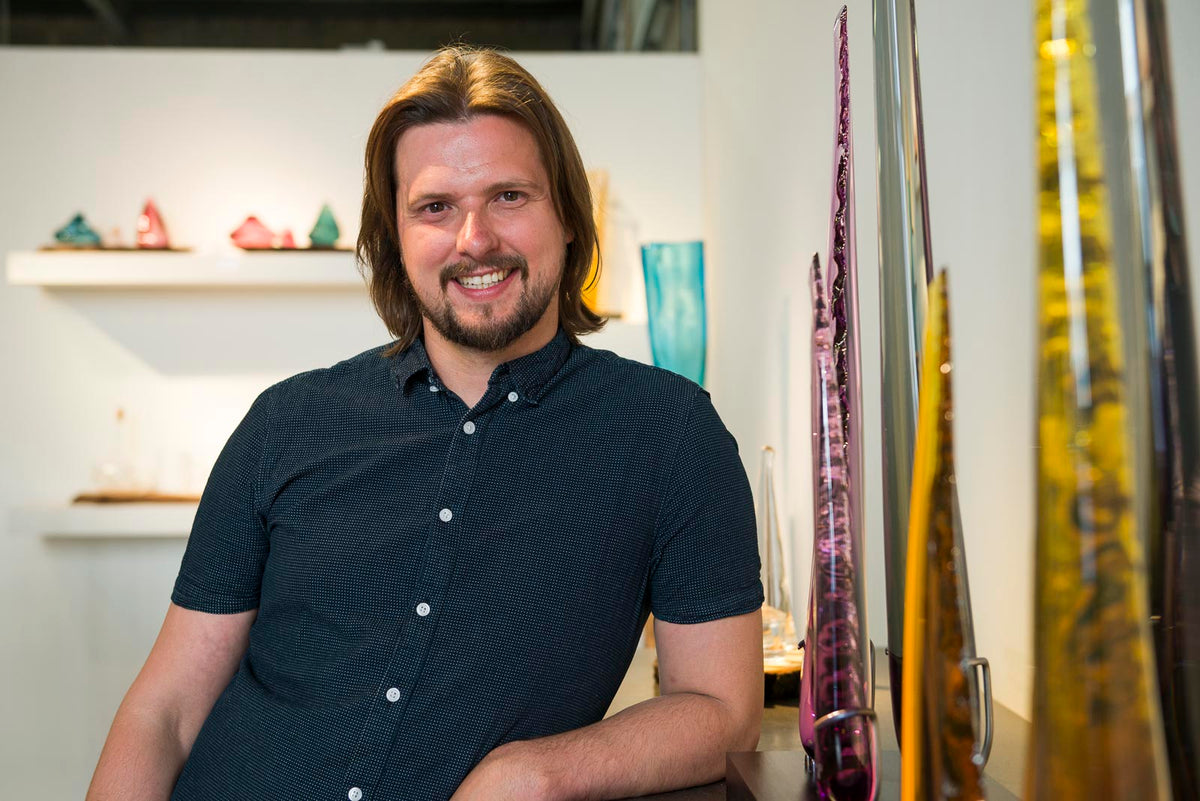
James Devereux: Chipped Glass Sculpture
James Devereux has worked in glass since the age of 15, when he discovered a natural talent for the craft. He specialises in hot glass, making both solid forms and blown pieces. He is best known for his Clovis Collection: monolithic sculptures made by chipping hot glass as if it were stone, where smooth lines meet fractured edges. He works from Devereux and Huskie Glassworks, the Wiltshire studio he runs with glass artist Katherine Huskie.
James Devereux at London Glassblowing
- Clovis - Blue & Ruby: hot-sculpted glass on a bespoke base, H78 x W20 x D15cm
- Fluke - Blue: hot-sculpted glass, H43.5 x W93 x D10cm
Our collection includes pieces from his Clovis and Fluke series, from a tall single Clovis form to large Clovis groups over 70cm high and wide, horizontal Fluke sculptures almost a metre across. James has demonstrated the making of his Clovis series in our studio, and gave a live demonstration with American artist David Patchen. You can see their joint work in our Devereux & Patchen collection. His Celt pair has sold but is available to commission.
From Bath to Wiltshire
James first worked with glass at 15, on a work experience placement at Bath Aqua Glass, and stayed on at weekends while he finished school. He went on to study glass design at university, working every holiday at a glassmaking factory in Bristol, and stayed there for several years after graduating.
In September 2008 he opened his first studio in the Wiltshire countryside, and the same year he began teaching. In 2009 he became glass technician at the Royal College of Art in London, building contacts that are still central to his work. After leaving London in 2013, he set up Devereux and Huskie Glassworks with Katherine Huskie. The studio offers space and technical support to visiting artists from the UK and overseas.
Over his career James has worked as a collaborating artist, facilitator, instructor and demonstrator. He has collaborated with glass artists including Louis Thompson, Liam Reeves, Simon Moore, KT Yun and David Patchen. He and Patchen met online and at a glass conference in Murano, and their collaboration began in San Francisco in 2019. Their work combines Patchen's patterns with Devereux's forms.
How James Devereux Glass Is Made
The Clovis Collection came out of long experiments to chip hot glass the way you would work stone.
- Chipping: James forms the glass, then chips away its surface while it is still hot. It takes deep knowledge of the material, because a blow too soft or too hard can shatter the piece.
- Flame polishing: the fractured edges are flame polished, so although they look sharp they are smooth enough to touch.
- Mounting: many Clovis pieces sit on bespoke bases, and some sets are mounted on hand-brushed black aluminium.
- Fluke and Celt use the same chipped-glass technique, in wider horizontal forms and paired pieces.
Ancient Artefacts and Discovery
James often explores our fascination with ancient artefacts: the stories of worship, sacrifice and survival they carry, and the skill of the people who made them. His Clovis, Celt and Fluke pieces echo early stone tools in both form and surface. He works largely through process and experiment, and prefers not to know exactly what a piece will become, so that each one keeps a sense of discovery.
Exhibitions and Events
- Collective Genius: Masterpieces from the Devereux & Huskie Glassworks, 2016
- GATHER: online demonstration of the Clovis series, London Glassblowing
- Online demonstration with David Patchen, London Glassblowing
Recognition
- Listed as a Master Artisan by Homo Faber, the Michelangelo Foundation's craft directory
Buying James Devereux Glass
Each James Devereux sculpture is unique and made by hand at his Wiltshire studio. Sold pieces such as Celt can be commissioned, and the Clovis and Fluke series can be made in other colours and sizes. To view a piece at our Bermondsey Street gallery or discuss a commission, please contact our gallery team.


